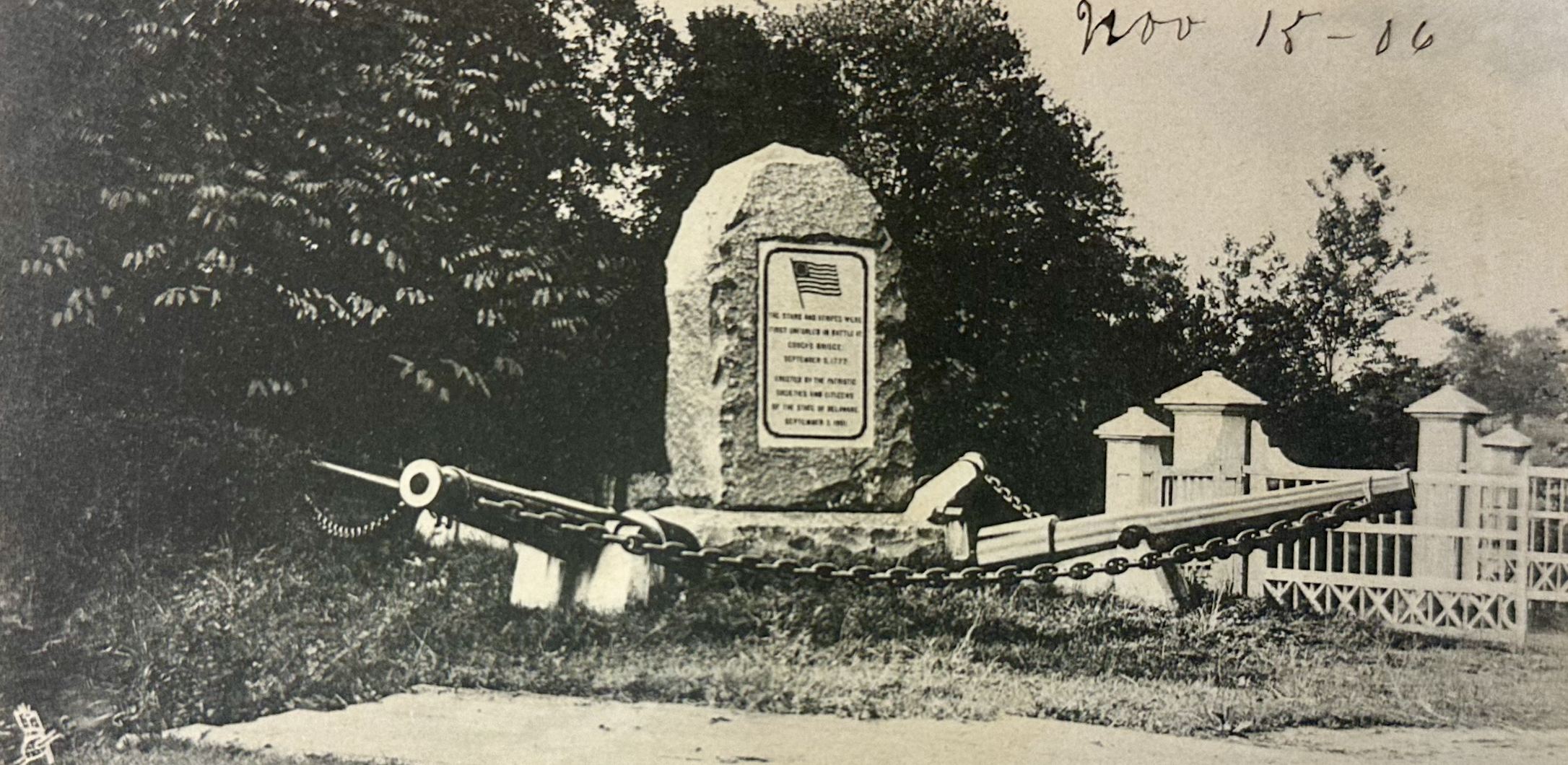
Memory and Delaware's “...patriotic societies and citizens...”
Lázló Kürti, author of "Picture Perfect: Community and Commemoration in Postcards," describes postcards’ ability to “...essentialise and sanitise ideas into miniature representations of multiple worlds.” This concept is illustrated by an early twentieth-century postcard depicting the monument at Cooch’s Bridge, an object that serves as a material record of a historical landscape and its commemorative narratives under negotiation.
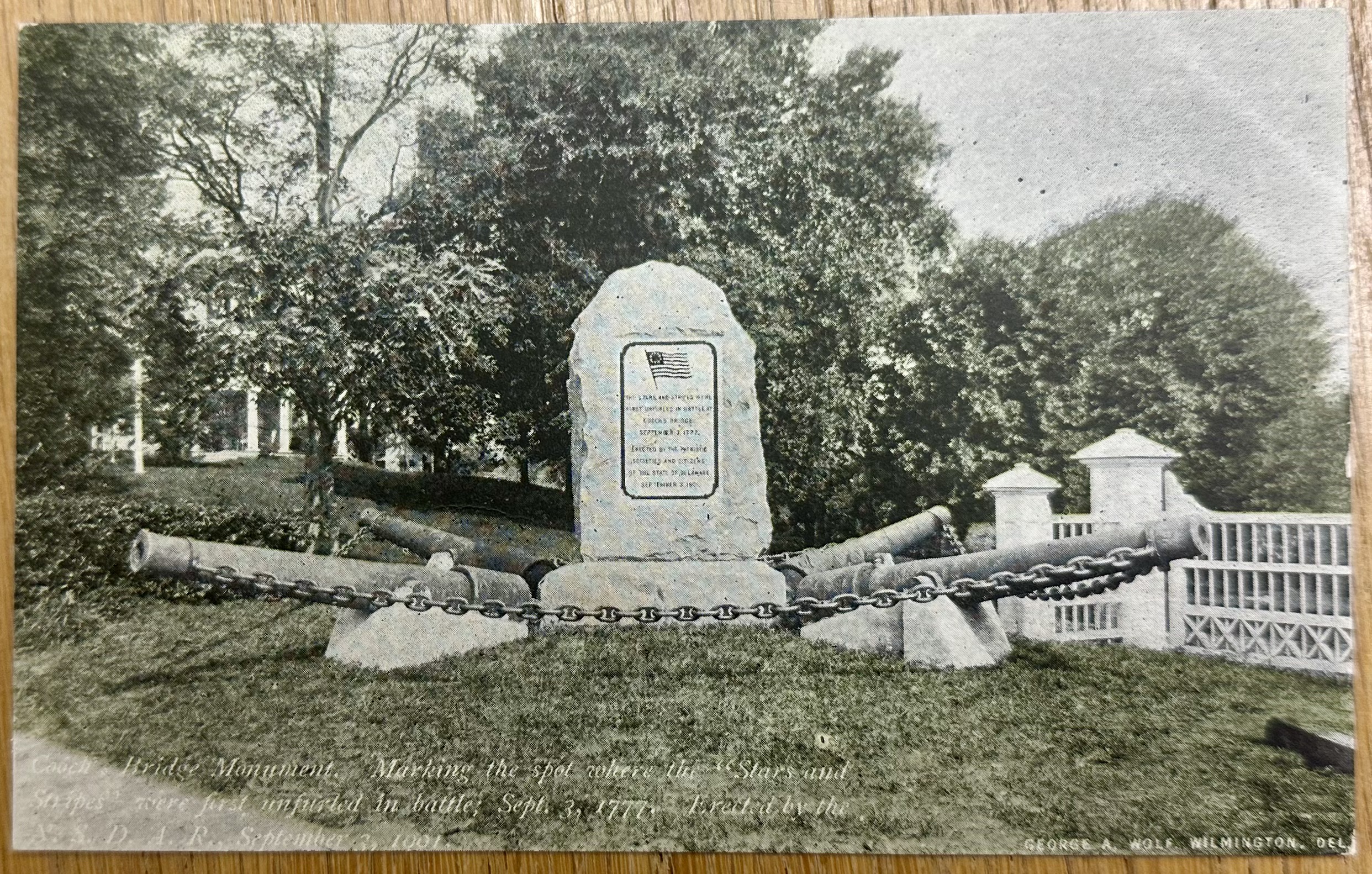
The monument outside of the historic Cooch homestead is a common subject in Delawarean postcards, likely undergirding a belief that this site, the location of the only Revolutionary War-era battle fought on Delaware soil, is significant within the state’s history and worthy of demarcation. This same postcard, however, with the caption “Cooch’s Bridge Monument. Marking the spot where the “Stars and Stripes” were first unfurled in battle; Sept. 3, 1777. Erected by the N.S.D.A.R. September 3, 1901.” also reflects concerted efforts by the National Society of the Daughters of the American Revolution to commemorate this site along patriotic lines and influence how Delawareans collectively remember its importance within a state context.
The commemorative acts present in both the monument and in the specificity of its caption is further evidenced when considered alongside other early twentieth century postcards depicting the same subject. While most in the Pfeiffer and Caley collection follow suit by referring to the Newark site as that of the alleged first flying of the “Stars and Stripes,” this 1901 example is the only to credit the Daughters of the American Revolution explicitly as those among the memory activists comprising the “...patriotic societies and citizens of the State of Delaware” who erected the monument.
While the motivation behind this small detail may never be uncovered, it is still a meaningful contribution to the construction of a local commemorative narrative. The accumulation of commemorative acts like these influence not only how commemorative narratives are formed, but how members of the public perceive the significance of these narratives within their own daily lives.
A 1906 picture postcard of the Historical Society of Delaware’s former location, the Old First Presbyterian Church in Wilmington, also speaks to this process and the impact memory activists like the Daughters of the American Revolution can have in solidifying the status of figures, sites, events, and structures as historic and worthy of commemoration. The postcard’s brief, somewhat melancholic inscription reads “This is on Wilmington’s principle [sic] street. What have we done to be thus affected [?]”
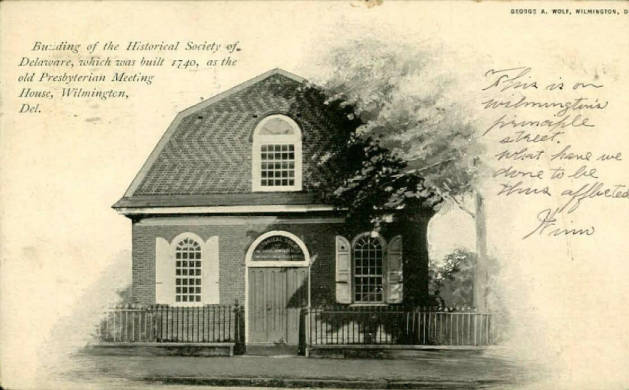
Constructed in 1740 for the congregants of the First Presbyterian Church, the building was threatened by the city’s rapid growth at the turn of the twentieth century and at risk of demolition. In 1918, the structure was disassembled and relocated by the Delaware chapters of the National Society of The Colonial Dames of America and the Society of Colonial Wars. The postcard’s sender was likely familiar with the risks the building was facing and may have wanted to share their concern about its future twelve years before efforts to preserve the historic church would prove successful.
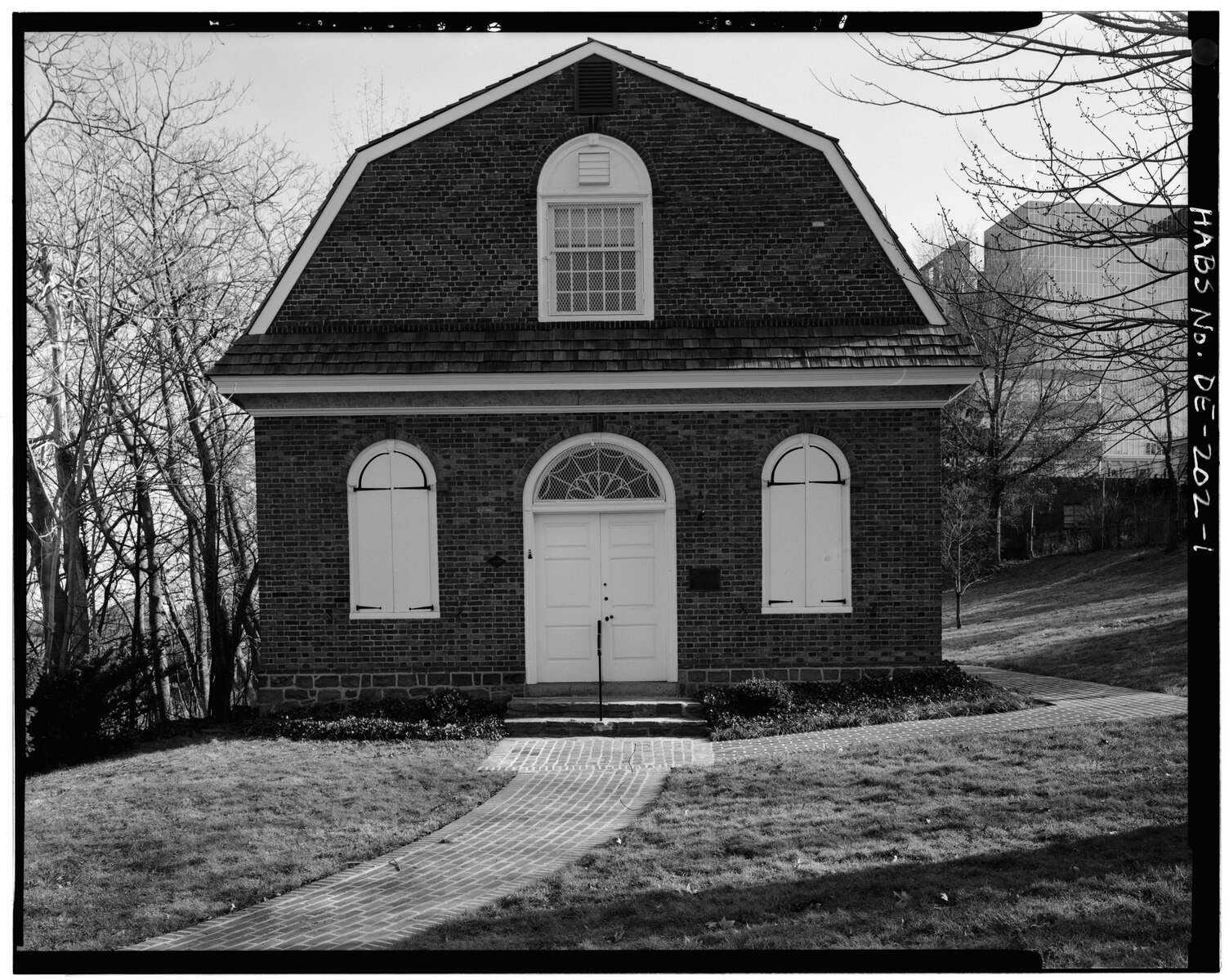
Michel-Rolph Trouillot’s distinction between history as ‘what happened’ and ‘that which is said to have happened’ as evidenced in commemorative acts recorded through postcards is on full display here with this postcard in an almost stereoscopic presentation. A commercial product – the medium for an intersection between local historical knowledge, ongoing preservation efforts that altered the commemorative narrative surrounding the church, and the instance of the sender determining that their interpretation of this history was worth noting and sharing – is transformed by another commemorative act into a collected, archived object, with the meanings and motivations behind its layered acts quietly committed to the historical record.