Individual Interpretations
The “‘democratization of the visual image’” achieved by the postcard at the turn of the twentieth century facilitated a familiarity that encouraged and perhaps even emboldened diverse interpretations of postcards’ subject matter. Interventions, such as that seen in this 1906 postcard, could subvert or completely recontextualize the intended message of the image and, if present, its caption. Postmarked in Dover on the evening of August 1, 1906, this postcard depicts the cenotaph of Caesar Rodney, a signer of the Declaration of Independence, owner of Byfield plantation in Kent County, and Delaware's fourth president (a role later reclassified to governor after Delaware ratified the Constitution in 1787).
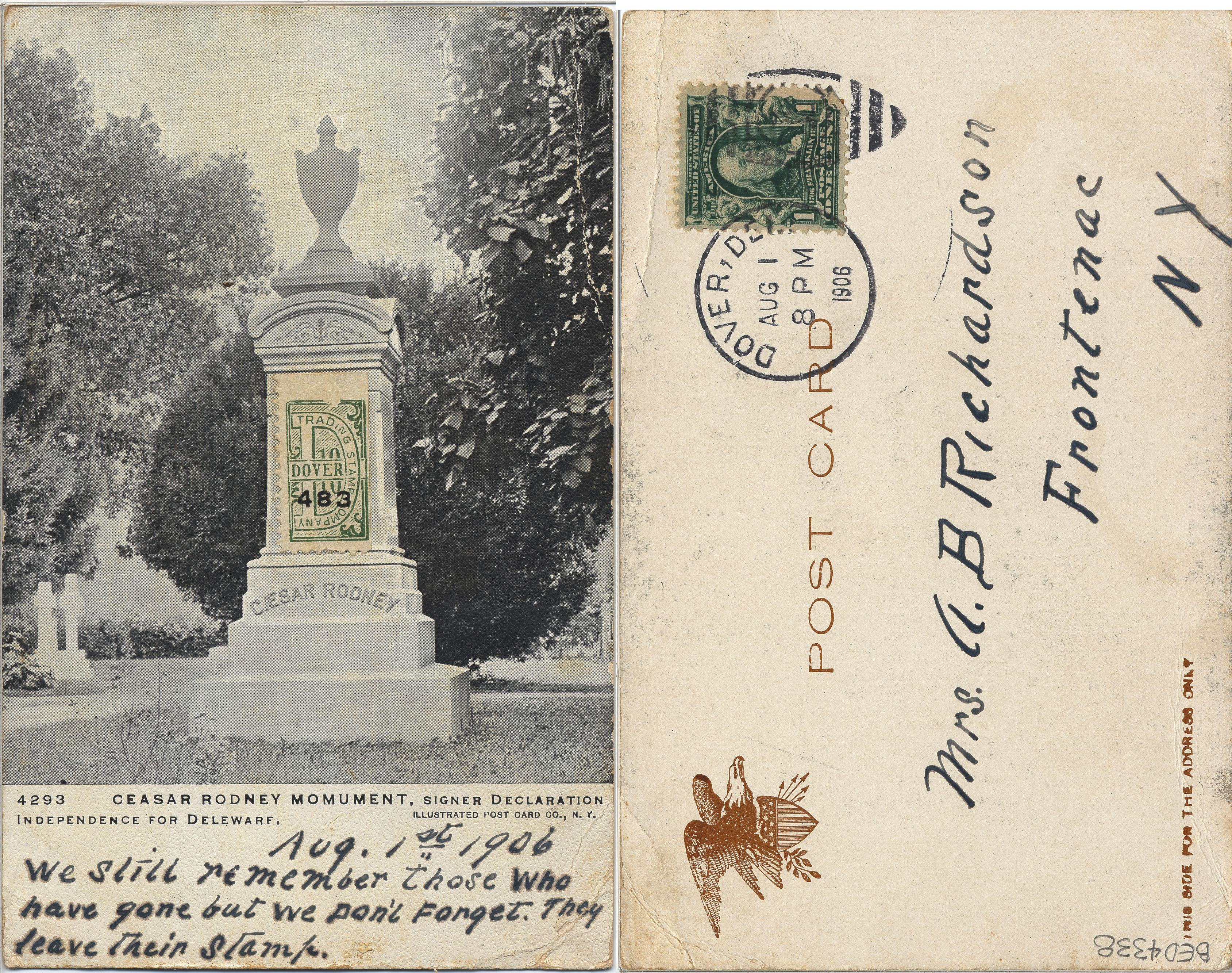
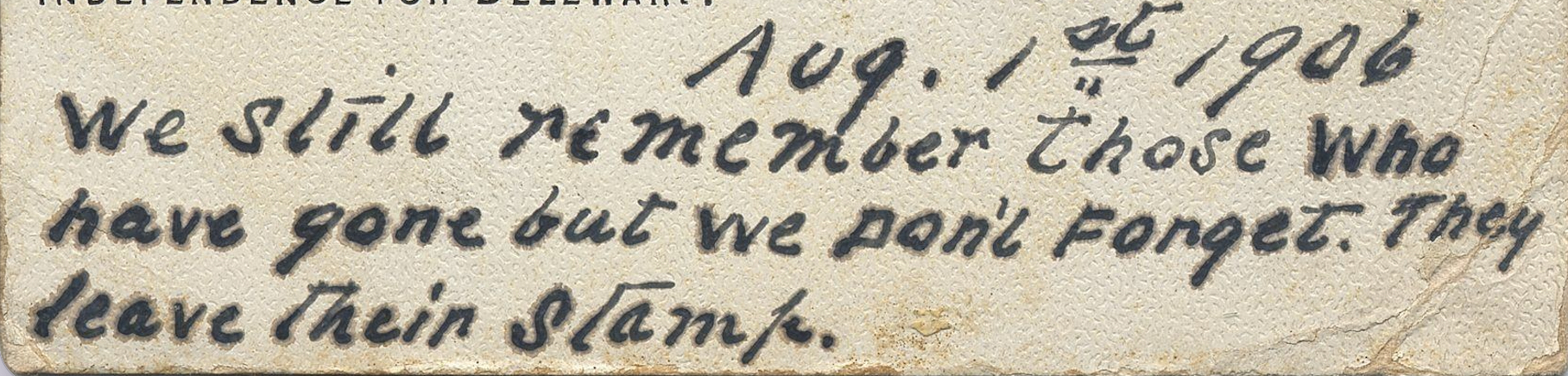
While the sender of this postcard was once known, little information remains today to identify who sent the postcard to one Mrs. A. B. Richardson in Frontenac, New York, and why. A brief note beneath the postcard’s subject offers one clue. The handwritten message, reading "We still remember those who have gone but we don't forget. They leave their stamp," suggests the writer held a reflective, potentially reverent attitude towards Rodney and other historic Delaware figures at the instance of writing that they felt compelled to share without elaboration in a longer message. A green and white Dover Trading Stamp Company stamp, intricately designed with flowing, curvilinear designs resembling those of the monument it is placed upon, stands in strong contrast against the black and white image, evoking a sense of growth in an otherwise somewhat static and mournful scene.
Unraveling the “...extremely tightly woven visual and written [narrative]...” of this postcard reveals an intentionally dense layering of memory and meaning.
The act of affixing the stamp alongside the use of the first person plural in the inscription is evidence of the then-present moment irrevocably merging with a larger Delawarean history. These commemorative actions demonstrate what the writer of this postcard found worth remembering about the history communicated by that local landmark, and illustrate that they unabashedly considered themselves a part of it. ‘Ordinary’ postcards, often represented in Delawarean collections through sunny scenes of Rehoboth Beach or inscriptions detailing the inner workings of daily life such as the arrival times of trains or the wellbeing of family members, are as equally representative as this postcard of reconciliations between a person’s lived experience and the histories, or interpretations of said histories, that they might engage with and find meaningful through the day-to-day of their lives.