Collecting and Commemorating
As collectors, and thus both actors and narrators in the historical process, George L. Caley and Gordon A. Pfeiffer contributed an additional commemorative act to the body of postcards within their collections at their moment of creation by virtue of the recognition that, in their eyes, the postcards comprising their collections are adequate representations of Delaware’s history.
George Luther Caley was an author, genealogist, historian of the Smyrna-Clayton area in Delaware, and an avid postcard collector. His entry into deltiology was shortly followed by a May 19, 1898 Act of Congress, which allowed private printing companies to produce postcards. This legislation ushered in a golden age of postcard collecting at the turn of the twentieth century. Caley documented the subsequent emergence of regional networks of production in his 1973 book Postcards of Yesteryear: 1893-1926, Delaware and Elsewhere, where he noted that three producers—George A. Wolf and Zeb in Wilmington, and Lefferts in Milford—dominated local card production in the state. Caley notes, however, that he himself did not encounter a Delaware postcard until 1901, and that postcards didn't reach smaller towns like Smyrna until 1904, with local imagery following in 1906.
Caley began collecting what he described as “...those colored bits of stiff paper…known as postal cards” after receiving his first postcard commemorating the Colombian Exposition as a child in 1893.
Caley’s commitment to the preservation of the state’s history was apparent not only in his desire to collate a comprehensive record of ephemera documenting its history in the early to mid twentieth century, but also in his work with organizations such as the Delaware Division of Historical and Cultural Affairs and the Delaware Public Archives. Caley’s postcard collection, however, demonstrates that his involvement surpassed preservation. Not only did Caley participate in “...the disregard for the authority of the object’s original intention and the willful re-coding of its meaning…” through creating his collection and collecting with “Delawareana,” a term Caley used to denote his own local interest in the state and “to describe infectious good feelings about Delaware,” in mind, but he became an active participant in the formation of a uniquely Delawarean commemorative narrative during the 1976 bicentennial.
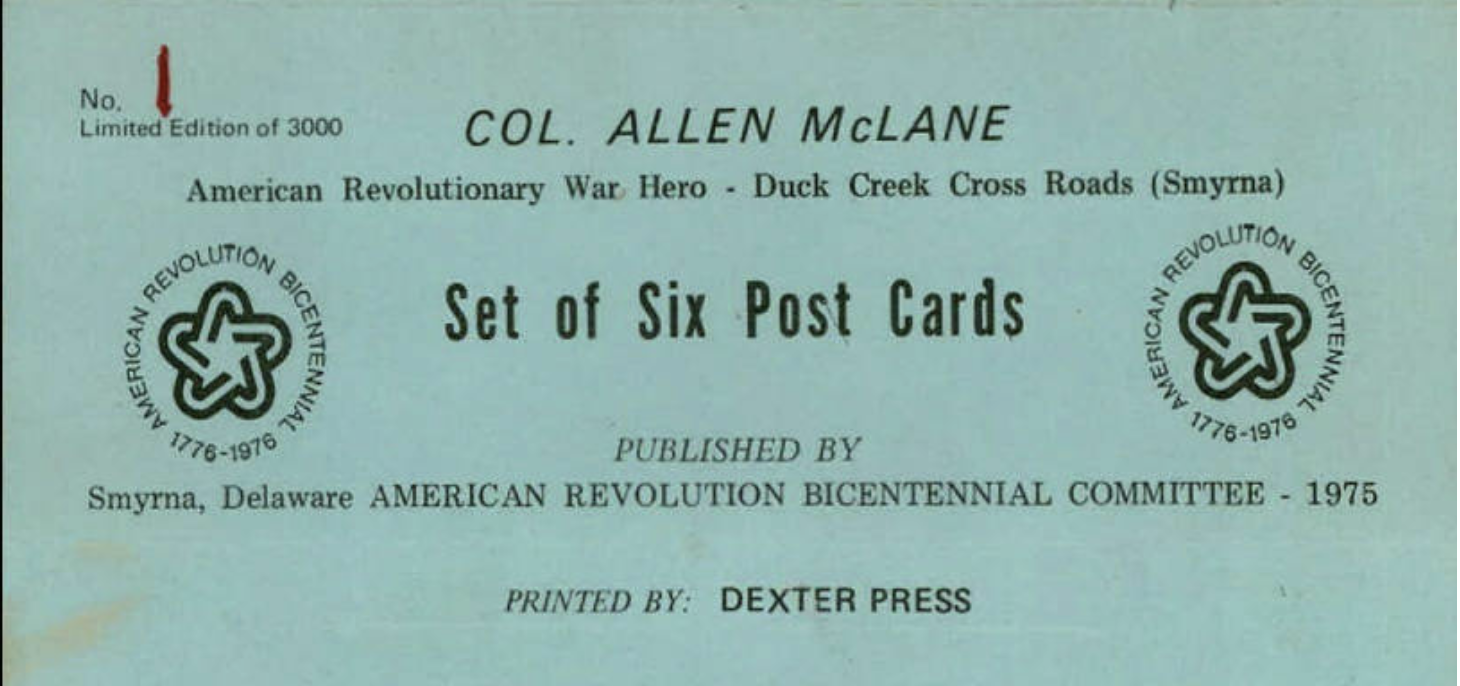
A set of postcards memorializing Colonel Allen McLane, a Revolutionary War veteran and resident of Smyrna, published by the Smyrna Delaware American Revolution Bicentennial Committee in 1975 contains traces of Caley’s commemorative acts. Caley was likely aware of his own presence within his collection and the impact it may have had on understanding the objects within a broader, historical Delaware context, as two copies of this set exist in the collection—one with his annotations, and one without.
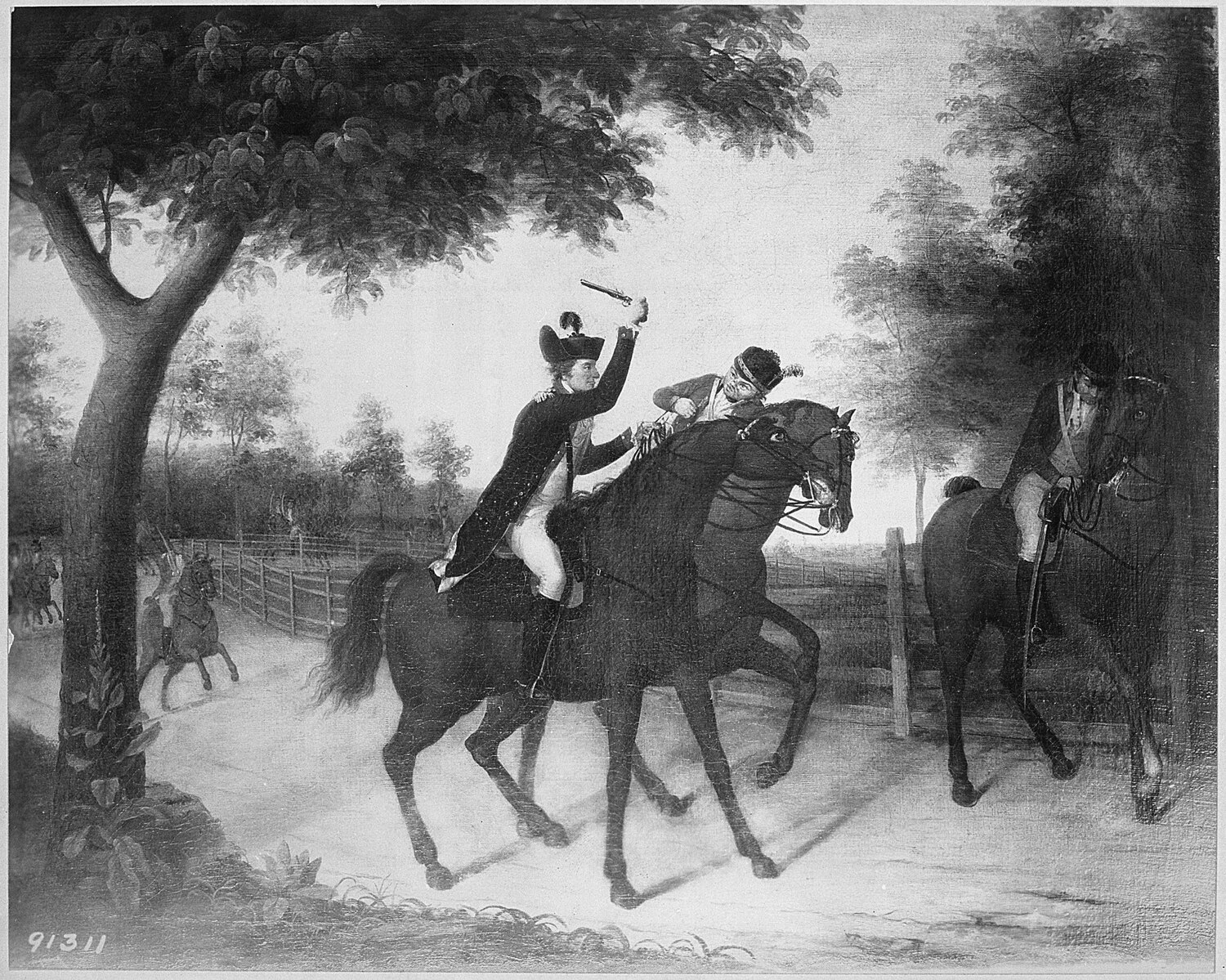
In these notes, taken on two of the six postcards, Caley provides his name and address; cancelled stamps and a Smyrna postmark suggest Caley may have mailed these to himself to secure the commemorative cancellation associated with the set. When taken alongside a note describing Caley’s anticipation of the set’s general distribution throughout the state, it is reasonable to assume Caley’s involvement in the creation of the set warranted his early access to it in this, the first set produced within a limited number of three thousand.
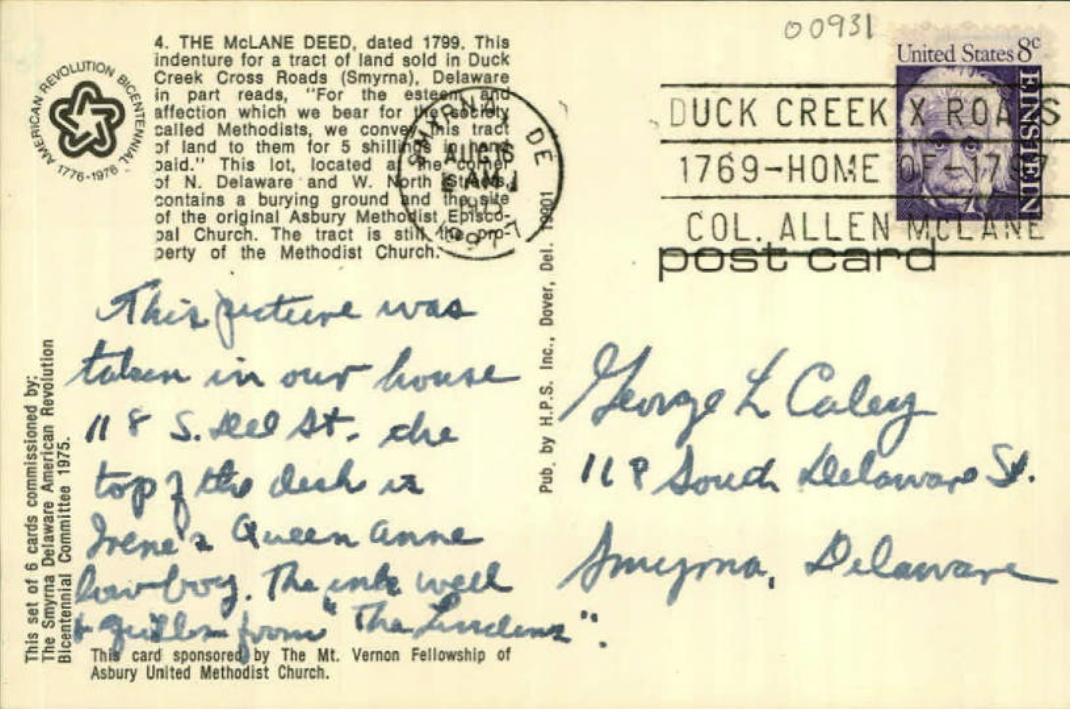
A final annotation, left on the message side of a postcard depicting a desk staged with a reproduction of the 1799 McLane deed, an inkwell, and quills, illustrates that this participation extended into his personal life. Caley notes that the photograph was taken within his and his wife Irene’s home, on Irene’s Queen Anne lowboy, an eighteenth-century furniture form likely selected for use in this postcard set for its connections to the colonial period.